
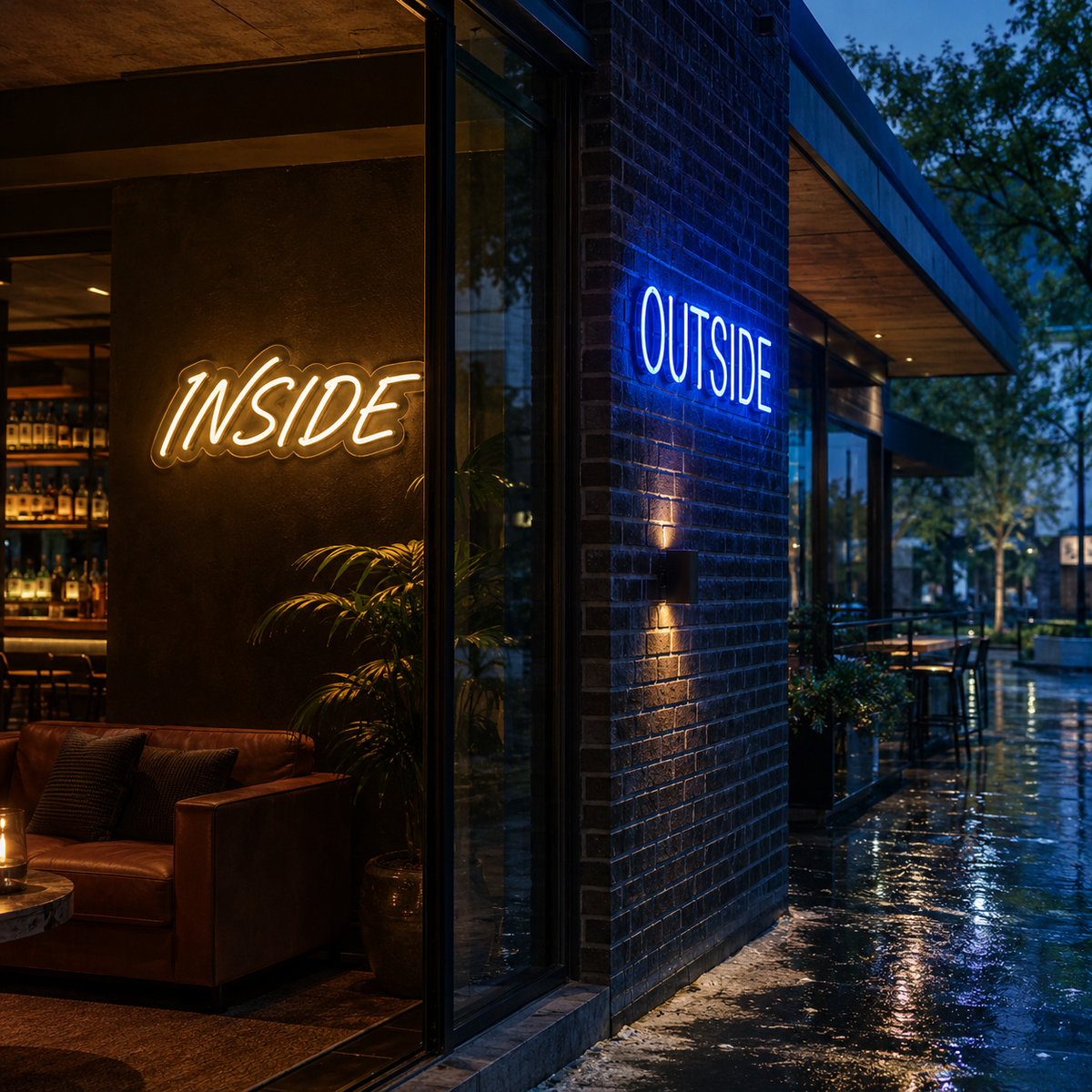
Indoor Vs Outdoor Neon Signs: What To Know Before You Buy
So you have landed on a design you love, picked your colours, and you are ready to order a custom neon sign. There is just one question left, and it is bigger than most people expect: is this sign going indoors or outdoors? Get that answer wrong and you could end up with a sign that fades, fogs up, or stops working within a season. Get it right, and it will still be glowing years from now.
Why The Difference Actually Matters
Neon signs, especially the modern LED neon signs most Australian businesses use today, are not one size fits all products. An indoor sign hanging above a café counter lives an easy life. Steady temperature, no rain, no direct sun, no salty coastal air chewing away at its components. An outdoor sign above a shopfront is a different story entirely. It cops summer heat that can climb well past 40 degrees in parts of Queensland and Western Australia, sudden downpours, and UV exposure that will bleach cheap materials within months.
This is the part a lot of first-time buyers miss. The sign might look identical in a product photo, but what is happening inside the acrylic backing and around the LED neon flex determines whether it survives outside at all. A sign built for indoor use, placed outdoors, is not a minor risk. It is close to a guarantee of failure, usually somewhere between six months and two years, right when you are relying on it most.
Indoor Neon Signs: Built For Controlled Environments
Indoor neon signs are the more forgiving of the two, and honestly, most personal and small business orders fall into this category. Think bedroom wall art, cafés, retail fitouts, salons, home bars. Because there is no weather to fight, manufacturers can use lighter acrylic backing, simpler standoff mounts, and standard power adaptors without worrying about water ingress.
That does not mean indoor signs are lower quality. If anything, it frees up design options. You get finer detail in the neon flex bends, more colour choices, and often a slightly lower price point because the sign does not need extra sealing or protective coating. An indoor sign can be mounted with keyhole slots straight onto drywall, or set on a stand with a desk mount, and it will run happily for years as long as it stays dry and out of direct, prolonged sun through a window.
One thing worth flagging here: a sign sitting behind glass in a shopfront window is still technically indoors, but it can bake in the sun for hours a day. If that is your setup, mention it when you order. A slightly more UV-resistant finish is a small upgrade that saves you a headache later.
Outdoor Neon Signs: Built To Handle The Elements
Outdoor neon signs are a different build altogether, and this is where a lot of buyers get caught out by price comparisons that do not compare apples with apples. A genuine outdoor-rated sign uses sealed, waterproof LED neon flex, a weatherproof power adaptor, and mounting hardware that will not corrode. Cavity anchors or heavy duty standoff mounts are common, since the sign needs to stay firmly attached through wind and vibration, not just gravity.
The backing material matters just as much. Outdoor signs typically use a thicker, UV-stabilised acrylic that resists yellowing, paired with edge sealing so moisture cannot creep in behind the neon flex. Skip this step and condensation builds up inside the sign, which is usually the first sign, no pun intended, that something is about to fail.
IP Ratings, In Plain English
You will see IP ratings mentioned constantly when shopping for outdoor signage, and it is worth understanding what the numbers actually mean rather than just trusting the label. IP stands for Ingress Protection, and it is followed by two digits. The first covers protection against dust and solid objects, the second covers protection against moisture. For an outdoor neon sign in Australia, you generally want at minimum IP65, which means fully dust protected and resistant to low pressure water jets from any direction. Coastal properties or anything exposed to driving rain should push for IP66 or higher.
If a supplier cannot tell you the IP rating of the sign they are selling you for outdoor use, that is a red flag worth paying attention to.
Materials, Mounting And Power
Beyond the neon flex itself, three things separate a sign that lasts from one that does not: the backing, the mounting hardware, and the power supply.
Acrylic backing thickness and UV stabilisation affect both clarity and longevity. Thin, untreated acrylic will discolour outdoors, turning a crisp white sign faintly yellow within a year or two. Mounting hardware needs to match the environment too. Stainless steel standoff mounts or coated cavity anchors resist rust, while standard mild steel fittings will streak and corrode against a painted shopfront wall embarrassingly fast.
Power adaptors are the quiet hero of any neon sign, and the one component people forget to ask about. Indoor adaptors are not weatherproof and should never be left exposed to rain, even briefly. Outdoor installations need a sealed, weatherproof adaptor housed somewhere protected, or rated for direct exposure if that is not possible. It is also worth checking cable length before installation day. Running short is a common and completely avoidable frustration.
Which One Is Right For Your Space
If your sign lives inside four walls, under a roof, away from direct weather, an indoor neon sign will serve you well and gives you more creative freedom for less cost. If it is going above a doorway, on an external wall, in a courtyard, or anywhere rain or direct sun can reach it, you need an outdoor-rated build from the start. Do not assume a sign can be upgraded later. Retrofitting weatherproofing onto an indoor sign is rarely possible and never as reliable as building it correctly the first time.
There is a middle case worth mentioning too: semi-outdoor spots like covered alfresco areas or under an awning. These still see humidity and temperature swings, even without direct rain, so it is worth erring toward an outdoor build rather than assuming partial shelter is enough.
Get It Right The First Time
A custom neon sign is meant to be a long-term investment in your brand or your space, not something you are replacing every winter. Telling your supplier exactly where the sign will hang, including how exposed it is to sun, rain or coastal air, is the single most useful piece of information you can give before production starts.
At Neon Cloud, every custom neon sign is built to match its environment, with the right acrylic backing, sealing and mounting hardware for indoor or outdoor use. Browse our range or get a custom quote at neoncloud.com.au and we will help you choose the right build before you order.